

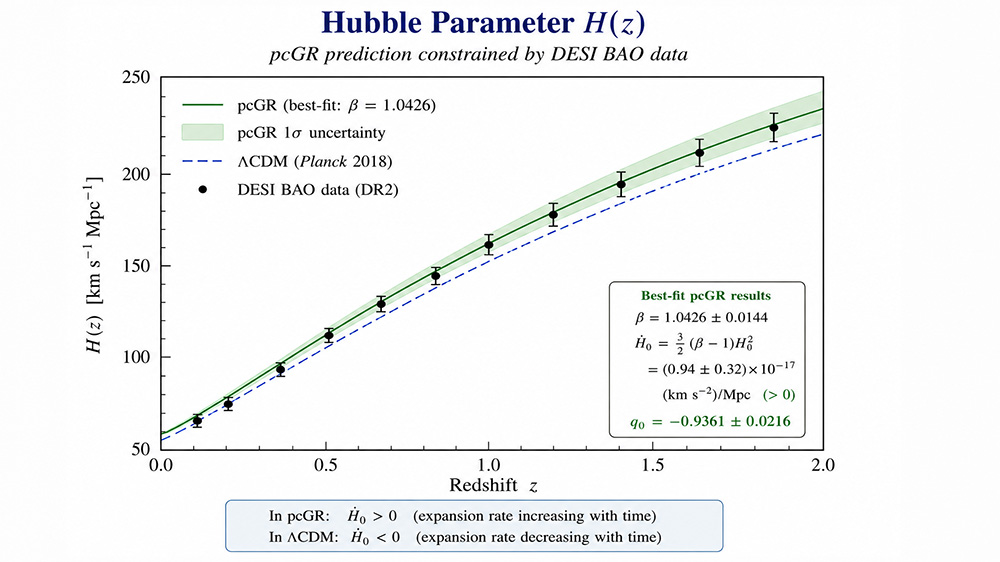
Professor Fridolin Weber (SDSU Physics) co-authored a new paper published in The European Physical Journal C exploring an alternative cosmological model based on pseudo-complex general relativity. The study investigates how the expansion rate of the universe evolves over time and compares the model’s predictions with recent observations from the Dark Energy Spectroscopic Instrument (DESI).
The work shows that dark energy may emerge naturally from the geometric structure of spacetime rather than from an added cosmological constant. Using DESI baryon acoustic oscillation data, the authors constrain the model and derive predictions for the time evolution of the Hubble parameter and the future measurement of cosmic redshift drift.
The paper, titled “The pseudo-complex FLRW model and the time evolution of the Hubble parameter,” was authored by L. Maghlaoui, P. O. Hess, Fridolin Weber, and C. A. Zen Vasconcellos and published in Eur. Phys. J. C 86, 373 (2026). https://link.springer.com/article/10.1140/epjc/s10052-026-15613-3